
Renovating an old bathroom? Start by looking at its age
Not every old bathroom is technically the same.
A bathroom that is fifteen years old can have a very different starting point from one that was installed forty years ago and has been altered several times since.
Those alterations make a difference.
Perhaps only the sanitaryware was replaced at some point. Maybe new tiles were installed over an existing finish. Or pipes and connections were added over the years.
Try to find out as much as possible about the bathroom beforehand.
When was it installed? Has it been renovated before? Are there drawings or photos of previous work available?
Any information can help you better understand the existing situation.
Look beyond dated tiles and sanitaryware
In an old bathroom, its appearance is usually the first thing you notice.
Small tiles, an outdated shower enclosure, an old-fashioned vanity unit or colours that no longer suit the home can be a strong reason to renovate.
But the visible elements are only the outer layer.
Behind the finish are technical components that will shape the new bathroom.
That is why it is wise not to see a renovation as purely a cosmetic change.
It is an opportunity to take a fresh look at the entire space.
Renovating an old bathroom also means assessing the foundation
When renovating an old bathroom, you ultimately want a solid base for the new finishes.
This matters because new tiles and other materials depend on the surface they are installed on.
A wall may look perfectly fine from the outside, while the condition of the structure behind it only becomes clear once the old finish is removed.
The same applies to the floor.
That is why, in an older bathroom, you need to allow for what may become visible when the existing bathroom is removed.
Why the foundation makes such a difference
Imagine investing in beautiful large tiles and high-quality sanitaryware.
You want these elements to be part of a bathroom that has been built with technical care.
There is little point in focusing solely on the visible end result while overlooking what lies underneath.
A complete renovation gives you the opportunity to bring both together.
What happens to old pipes?
Pipes are an important consideration in an older bathroom.
Not because old automatically means poor quality, but because a complete renovation requires you to assess whether the existing setup suits the new design.
Perhaps you want the shower in a different position.
Maybe you are choosing a different type of vanity unit.
Or you want a bathroom with a layout that no longer resembles the current space at all.
The connections need to be adapted accordingly.
Do not blindly stick to existing positions
In old bathrooms, sanitaryware was often placed according to the possibilities and preferences of the time.
That does not mean the same layout is still the best solution today.
If the bathroom is being fully renovated anyway, it is wise to reconsider how the available space can be used best.
Sometimes the existing layout works perfectly well.
In other cases, moving the shower, toilet or basin can make the bathroom much more enjoyable to use.
Be aware of bathrooms that have been altered several times
An older bathroom may have been through several renovations.
You may notice this through mismatched tiles, different types of sealant or sanitaryware from different eras.
But not every alteration is visible.
When a space has been changed multiple times, there may be a mix of old and newer solutions behind the finish.
A complete renovation provides the opportunity to bring structure back to the space.
Instead of adding yet another adjustment to what is already there, you work towards one new bathroom.
This not only creates a fresher appearance, but above all provides a clear starting point.
Use your old bathroom as a source of information
There is also an advantage to having used the same bathroom for years.
You know exactly what bothers you about it.
That is valuable information for the renovation.
Take a conscious look at your daily routine and write down what could be improved.
Is something always in the way?
Do you have too little space around the basin?
Is the shower smaller than you would like?
Do you have nowhere practical to keep towels?
Do you have lots of items lying around because there is not enough cupboard space?
These are concrete problems that the new design can solve.
Also note what does work well
Not everything needs to change just because the bathroom is old.
Perhaps you find the position of the basin ideal. Maybe the shower is well positioned, or you like that the toilet is not immediately visible when you walk in.
Include those positive points too.
A good renovation is not about changing as much as possible. It is about making better choices.
Renovating an old bathroom with a modern layout
Renovating an old bathroom is an opportunity to consider living preferences that may have changed over the years.
Modern bathrooms, for example, are often designed to feel much calmer.
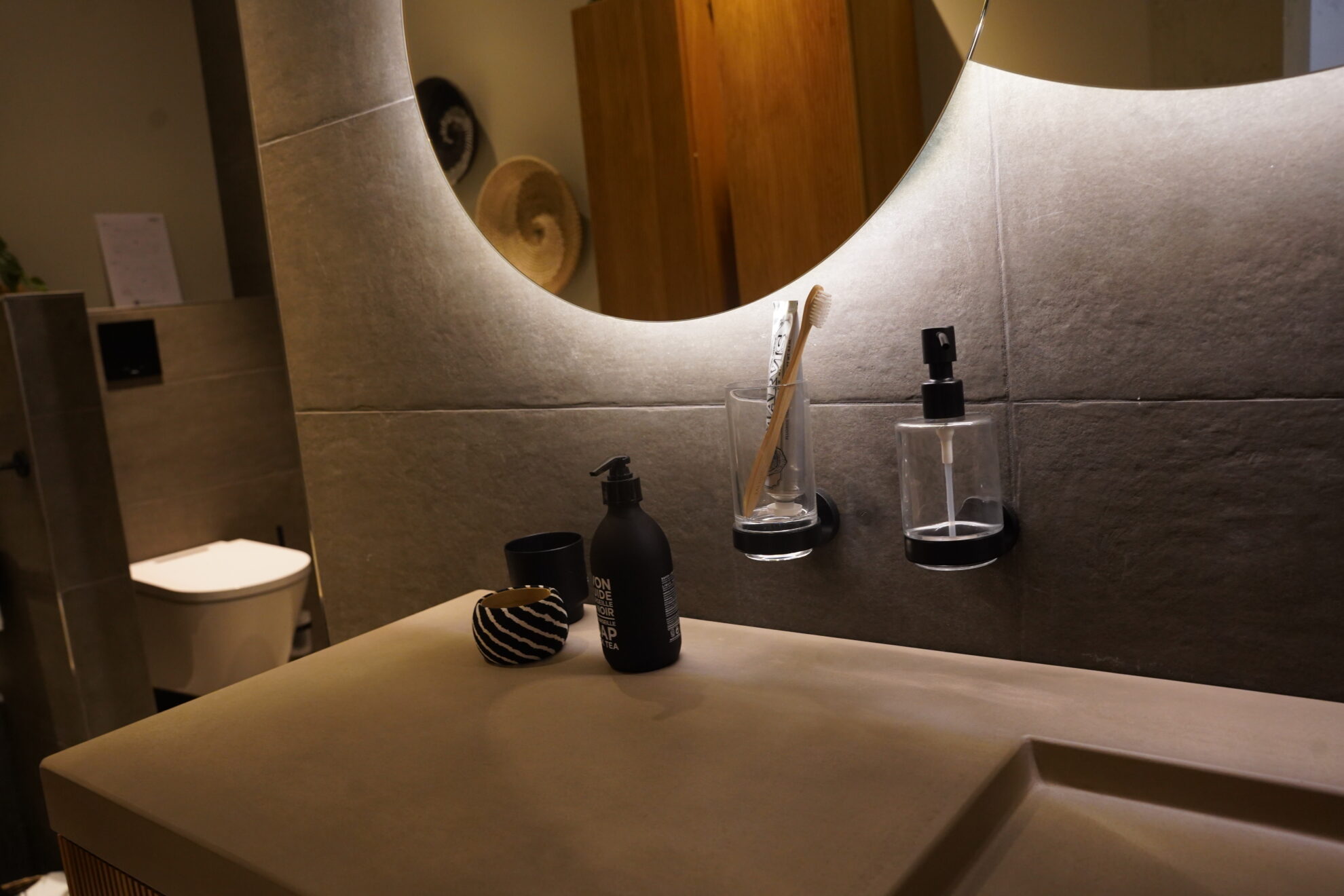
Separate small cabinets can make way for one spacious unit with wide drawers. A closed shower enclosure may be replaced with a more open shower area. A large mirror can make the room feel more spacious.
Storage also receives more attention nowadays.
That makes sense. We use many care products and appliances in the bathroom that you would rather not keep in view all the time.
By including storage from the very start of the design, it is easier to keep the new bathroom calm and uncluttered.
Old house? Consider both the bathroom and the home
A bathroom is never entirely separate from the rest of the house.
Especially in an older home, it is wise to think about the relationship between the new bathroom and the property itself.
This does not mean a 1930s house automatically needs a classic bathroom.
A modern bathroom can look beautiful there too.
However, it helps to make conscious choices in materials, colours and shapes.
Warm natural stone looks, wood textures and soft colours can create a connection between modern comfort and the character of an older home.
This prevents the bathroom from feeling like a completely separate element.
Choose materials for more than appearance
Once the old bathroom is finally being replaced, it can be tempting to fall in love immediately with distinctive materials.
Of course, that is perfectly fine.
But alongside “Do I like this?”, ask yourself a few practical questions.
How easy is the surface to clean? How will the material work in this space? Does it suit the other selected colours? Will the bathroom become too busy if this material is used over a large area?
Scale is especially important when it comes to tiles.
A bold pattern that seems subtle on one tile can become much more dominant across an entire wall.
Try to view materials as part of the complete design.
Do not turn the journey from old to new into a collection of compromises
When designing a new bathroom, the existing situation can unintentionally have too much influence.
“The basin was already here.”
“The shower was there.”
“There has always been a pipe running through this wall.”
These are relevant details, but they do not automatically need to determine the new design.
When you fully renovate an old bathroom, this is the moment to explore which choices you would make if you could start again.
You can then assess which of these are technically and spatially feasible.
This often leads to better solutions than simply replacing every old element with a new version in exactly the same place.
Think further ahead with an old bathroom
You will not want to change a new bathroom again anytime soon.
So look beyond the style you like today.
For example, a calm base can be a smart choice if you are worried you may quickly tire of bold colours.
Practical needs deserve attention too.
How much storage do you actually need? Is the shower spacious enough? Are lots of small surfaces and corners easy to keep clean?
Try to assess every major choice from three perspectives: appearance, everyday use and future use.
When a choice works well in all three areas, you are much more likely to remain happy with it for years to come.
Renovating an old bathroom? Start with the foundation
Renovating an old bathroom is an opportunity to say goodbye to more than dated tiles and old sanitaryware.
You can reassess the technical foundation, layout, storage, materials and appearance of the entire space.
Especially in an older bathroom, it is important not to think only about what you can see. What is revealed behind the existing finishes can partly determine how the new bathroom is built.
That is why, at Jouwdroombadkamer, we believe in a complete approach that considers the room as a whole.
Would you like to fully renovate your old bathroom? Contact Jouwdroombadkamer and book a consultation. We will discuss your existing bathroom, wishes and possibilities, and explore a new bathroom that will suit you and your home for years to come.