
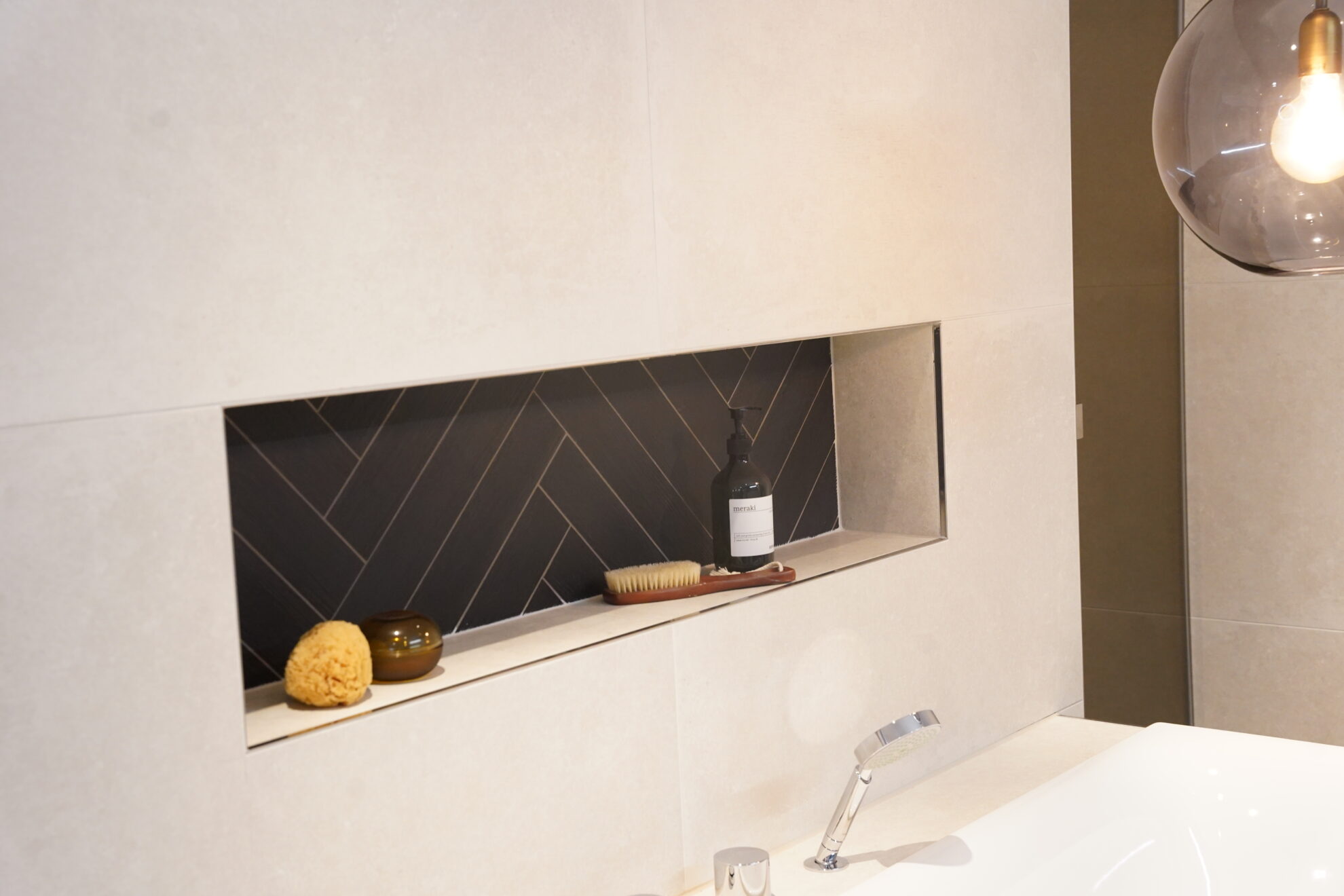
Combining a beige bathroom starts with choosing the right shade of beige
Beige is not one specific colour.
There are light sand shades, warm beige tones, greige colours and beige variations with more yellow, pink or grey undertones.
That difference matters.
For example, place a warm wood tone next to a cool grey-beige shade and the combination may look different from what you expected.
It is therefore best to view colours together.
Have you already chosen a tile? Use it as the starting point for your vanity unit, wall colour, sanitary ware and taps.
This prevents you from choosing materials that look beautiful individually but do not quite work together.
Combining beige with wood
Beige and wood are a natural combination.
Wood adds warmth and texture, while beige creates a calm base. This makes the combination especially suitable for creating a relaxing bathroom.
The wood tone you choose does make a big difference.
Light wood for a calm look
Light wood tones work well when you want to keep the bathroom airy.
Think of a light wood-look vanity unit combined with sand-coloured tiles. The colours are close together, creating few harsh contrasts.
This works particularly well in a minimalist or Japandi-inspired bathroom.
The result feels soft and natural.
Dark wood for a more luxurious look
Would you prefer more contrast?
Then darker wood can be an interesting choice.
A dark wooden vanity unit against a light beige wall naturally draws more attention. At the same time, the warm tone of the wood prevents the contrast from becoming too harsh.
Especially in a larger bathroom, this can create a luxurious feel.
Combining beige with white
White is a safe combination with beige, but safe certainly does not have to mean boring.
White sanitary ware adds freshness and prevents the entire bathroom from becoming one large beige surface.
For example, a white washbasin or freestanding bath will stand out subtly against beige tiles.
The contrast remains calm.
Do pay attention to the shade of white.
Very cool white next to a very warm beige can sometimes look harsher than intended. By viewing the materials next to each other, you can better see whether their undertones work well together.
Combining a beige bathroom with brown
Brown tones enhance the warm look of beige.
This does not only mean dark brown, but also colours such as taupe, coffee brown and soft earthy tones.
You do not need to use brown across large surfaces either.
A wooden vanity unit, a few accessories or a subtle detail may already be enough.
Because beige and brown belong to the same colour family, it is easy to create a calm colour palette.
Work with different shades
A bathroom becomes more interesting when not everything is exactly the same colour.
For example, combine light beige walls with a slightly darker sand-coloured floor, then add a wooden vanity unit.
You stay within the same warm colour palette while still creating depth.
This is also known as tone-on-tone styling.
The advantage is that the bathroom remains calm while there is still enough variation between the surfaces.
Can grey work in a beige bathroom?
Absolutely.
The combination simply requires a little more attention.
Cool grey can sometimes look distant next to very warm beige. A warm grey shade or greige usually blends more easily.
As the name suggests, greige sits between grey and beige.
This makes it a beautiful transition colour when you want to combine the warmth of beige with a more modern look.
Focus mainly on the undertones of both colours.
That is more important than the colour name on a sample.
Combining a beige bathroom with black details
Black and beige create a strong contrast.
Black details can therefore add structure to a light bathroom.
Think of the profile of a shower screen, the frame of a mirror or subtle accessories.
Use black deliberately, though.
If you add black accents everywhere possible, beige can lose its calm character.
A few well-chosen dark lines are often enough.
They give the interior definition without allowing black to take the leading role.
Brass and beige for a warm look
Brass can work beautifully with warm beige shades.
Where black creates a bold contrast, brass stays closer to the warm undertones of beige.
This can give the bathroom a refined appearance.
You could incorporate brass in taps, shower fittings or small details.
Try to remain consistent.
Mixing several metal finishes without a clear plan can make the bathroom feel busier. Repetition creates cohesion.
Add a natural stone look for more character
Do you find a fully plain beige bathroom a little too calm?
You can add texture without introducing another striking colour.
A natural stone look is a great option for this.
Think of tiles with subtle colour variations, veining or a stone-like texture.
You keep the calm colour palette while giving the surface more character.
This works especially well when you want to create a luxurious bathroom without using many different colours.
Combining a beige bathroom without making it boring
A common concern with beige is that the bathroom may become too boring.
This mainly happens when colour, material and texture all have very little variation.
The solution is not automatically adding more colour.
You can also create contrast with different surfaces.
For example, combine a smooth countertop with a wood texture. Place matt tiles next to glass. Or combine large, calm wall tiles with a subtle texture on one part of the wall.
This creates visual variation without making the bathroom feel busy.
Use only a few main tones
When you see many beautiful materials, it is tempting to keep adding something.
A different tile for the shower. Another colour behind the bath. A striking vanity unit. Different accessories.
Individually, everything may look beautiful, but together it can become too much.
A practical approach is therefore to first create a limited base palette.
For example:
- warm beige as the main colour;
- wood as the second material;
- white for the sanitary ware;
- one accent colour for details.
You do not have to follow this rule strictly, but it helps you assess your choices.
Does a new material not fit naturally within the palette? Leaving it out can sometimes be stronger than adding it.
View colours in different lighting conditions
A beige tile can look different in a showroom than it does at home.
Daylight, artificial light and the amount of light in the bathroom all influence how you experience a colour.
If possible, view material samples in different lighting conditions.
Also place tile and furniture samples next to each other instead of assessing them separately.
Choosing a colour is not just about whether one tile looks beautiful.
It is about whether all elements look beautiful together.
Consider the floor and walls as one whole
The floor covers a large area and therefore influences the entire colour palette.
You can use the same tile on the floor and walls to create a lot of calm. Another option is a slightly darker floor with lighter beige walls.
A darker floor can give the room more visual grounding, while light walls keep the bathroom airy.
Would you prefer a very minimalist result?
Then using the same tile colour across different surfaces can create a calm, almost seamless look.
Combining a beige bathroom? Create a material palette first
Before making final choices, it is wise to place all key materials together.
Include the floor tile, wall tile, vanity colour, washbasin, metal finish and any natural stone-look material.
Then look at the overall picture.
Is there enough contrast?
Do the warm and cool undertones match?
Is there one clear material that draws attention?
And does the overall look still feel calm?
Choosing in this way prevents you from putting the bathroom together piece by piece, only to discover afterwards that the colours do not work well together.
Choosing the right colours for your bathroom together
Combining a beige bathroom is ultimately about balance. Beige gives you a calm base, while wood, white, earthy tones, natural stone looks or metal details determine the final look and feel.
The most important thing is not to choose colours and materials separately.
At Jouwdroombadkamer, we look at the complete picture. Not only at which tile looks beautiful, but also at how it works with the vanity unit, sanitary ware and the rest of the room.
Would you like a beige bathroom but are unsure which colours and materials work best together? Contact Jouwdroombadkamer or book a consultation. Together, we will create a bathroom in which colours, materials and layout form one calm and stylish whole.