Why renovating a bathroom in an old house can be different
No two old houses are the same.
Even two similar houses on the same street can have completely different situations behind the walls. One property may have been renovated several times over the years, while another may still retain much of its original construction.
This can become particularly noticeable in the bathroom.
Perhaps new tiles were installed at some point without renovating the entire bathroom. The pipework may have been altered later, or the bathroom may now be located in a room that originally served a completely different purpose.
That is why the existing situation should always be the starting point, not just the age of the property.
Don’t automatically expect perfectly straight walls
In a modern home, we often assume that walls and corners are perfectly straight.
In older properties, that is not always the case.
A wall may be slightly out of plumb. A corner may not be exactly 90 degrees, and the floor may have small differences in height.
In an old bathroom, these imperfections may hardly be noticeable because the existing finishes have been part of the room for years.
As soon as you renovate and introduce sleek, modern materials, however, these irregularities can become much more visible.
Large tiles make lines more noticeable
Large tiles can create a beautiful, calm appearance.
But the larger and more streamlined the format, the more important a good foundation becomes.
A clear grout line next to an uneven wall can make the difference more noticeable. The same applies to a sleek bathroom vanity or glass shower screen.
That is why a beautiful end result does not start with the tile itself.
It starts with the surface on which the tile will eventually be installed.
Bathroom renovation in an old house: look behind the finishes
When renovating a bathroom in an old house, what you cannot see can be just as important as what you can see.
The existing bathroom only tells part of the story.
Behind the wall and floor finishes, previous alterations may become visible. Different materials may have been layered over one another, or parts of the room may have been renovated at different times.
During a complete renovation, the existing bathroom can be removed, giving you a much clearer picture of the underlying situation.
This is important for everything that follows.
After all, you want to build your new bathroom on a foundation that suits the new design.
Old pipework requires attention
An old house does not automatically mean that all the pipework is old.
It may already have been replaced during a previous renovation.
But you should not simply assume that either.
When the bathroom is completely renovated, it makes sense to assess which technical components are currently in place and whether they are suitable for the new situation.
This is especially important if you want to change the layout.
A new shower in a different location or a different type of washbasin may require different connections.
Consider what the new bathroom needs
The starting point should not only be: what is there now?
Just as important is: what will we need later?
This prevents the entire new bathroom from being designed around technical decisions that were originally made for a completely different bathroom.
Where possible, look for the best combination of the existing possibilities and your new requirements.
Previous renovations can reveal surprises
Old houses often have a history.
The same applies to bathrooms.
The original bathroom may already have been renovated decades ago. After that, perhaps the shower was replaced, followed by the vanity and, later, part of the tiling.
As a result, a single room can contain work carried out during several different periods.
You cannot always see this from the outside.
Only during a complete renovation may it become clear how certain parts were originally constructed.
This is one of the reasons why a tailored approach is so important in older properties.
In practice, the situation does not always match exactly what you expected beforehand.
Preserve the character without creating an old-fashioned bathroom
A common question when renovating a bathroom in an old house is which style best suits the property.
Does a bathroom in an older home automatically need to have a traditional design?
Absolutely not.
A sleek, modern bathroom can create a beautiful contrast with the historic features of a property.
However, it can be attractive to maintain some visual connection with the rest of the home.
This can be very subtle.
Use materials to connect old and new
Natural materials and warm colours, for example, work beautifully in many older properties.
Think of wood-effect finishes, warm natural-stone looks, beige, sand, taupe or deep earthy tones.
These can help you create a modern bathroom without making it feel cold or disconnected from the rest of the house.
Shapes can also help.
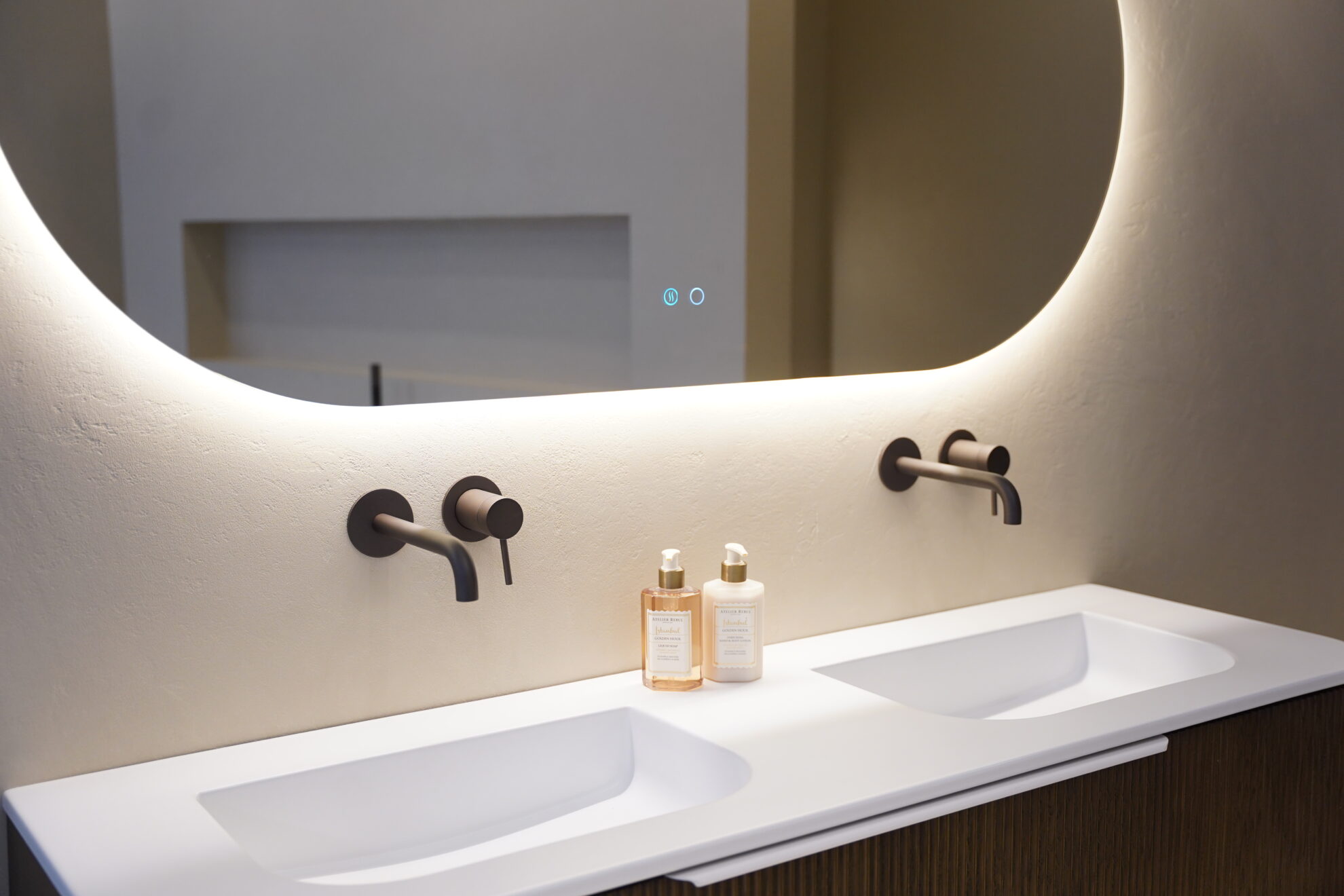
For example, a modern washbasin with soft curves can create a warmer appearance than a design consisting entirely of sharp, straight lines.
Make unusual features work in your favour
Not every irregularity in an old property needs to be hidden.
Sometimes an existing niche, unusual wall or angled line can actually add character to the design.
The key is to distinguish between something that needs to be corrected for technical reasons and something that can be interesting from a design perspective.
An unexpected corner, for example, may create opportunities for custom-made storage.
An existing niche could perhaps become part of the new design.
So don’t focus only on limitations.
Older properties can also offer possibilities that you are less likely to find in a standard new-build home.
Think carefully before copying the existing layout
A bathroom may have had the same layout for decades.
As a result, it can sometimes seem as though the sanitaryware can only be positioned in one particular way.
But that does not necessarily have to be the case.
Perhaps the existing layout once made sense because of the facilities available at the time. Or perhaps the previous residents simply had completely different requirements.
A complete renovation is therefore a good opportunity to reconsider the layout.
Is the current shower large enough?
Is the toilet in a convenient position?
Could a different bathroom vanity provide more storage?
Could you improve the sightline from the doorway?
Only if the existing layout still works well is there a strong reason to use it as the basis for the new bathroom.
Renovating an old-house bathroom with modern requirements
When renovating a bathroom in an old house, you often want the best of both worlds.
The character of the property can remain, while the comfort of the bathroom is brought completely up to date.
That might mean sufficient storage, a comfortable shower and a design that works well in everyday life.
A calm and spacious appearance is also important to many people.
You do not necessarily need a huge bathroom to achieve this.
Smart material choices, good sightlines and sanitaryware with the right proportions can make a relatively compact room feel much calmer and more spacious.
Don’t be misled by inspiration images
Inspiration is useful, but a photo does not tell the whole story.
A bathroom you see online may be twice the size of your own space. The ceiling height, amount of natural light and position of the windows may also be completely different.
In an older property, the characteristics of the house itself also play an important role.
Use inspiration images primarily to discover what you like.
Do not automatically copy the entire design.
Ask yourself which element appeals to you.
Is it the tile?
The colour combination?
The wood?
The calm layout?
The shape of the vanity?
Once you know that, you can translate the same atmosphere into a solution that actually suits your home.
Consider the proportions of the room
Older properties sometimes have compact bathrooms.
It can be tempting to try to fit every desired feature into the space.
A bath, walk-in shower, large vanity, toilet and tall cabinet may all sound appealing, but they all require space.
A bathroom does not feel luxurious simply because it contains as many features as possible.
Luxury can also come from having enough room to move comfortably.
A spacious shower and practical vanity may therefore provide more comfort than an additional bath that makes the room feel cramped.
Don’t be afraid to prioritise.
Make sure new elements truly fit the space
Standard dimensions are useful, but an older property sometimes requires extra attention to the actual measurements.
Even a small deviation in a wall can affect how a vanity or shower screen fits.
That is why it is important to assess the existing room accurately.
The design should fit the property as it really is.
Not just an ideal rectangle on a floor plan.
It may sound like a small detail, but these details ultimately determine how sleek and well-finished a bathroom looks.
Modern bathroom, timeless foundation
A complete renovation is also a good opportunity to think about how long you want to enjoy the chosen style.
In a characterful property, it can be attractive to combine current trends with a calm, timeless foundation.
For example, choose neutral tiles with a more distinctive vanity, or combine natural materials with modern taps.
This creates character without making every large surface dependent on current trends.
The advantage is that smaller details can be changed more easily in the future.
The foundation of the bathroom remains timeless.
Bathroom renovation in an old house requires a tailored approach
The most important lesson when renovating a bathroom in an old house is not to make too many assumptions.
Not every wall will automatically be straight.
Not every existing connection needs to determine the new layout.
And not every old characteristic of the property is a problem.
You need to look at what is actually there and then determine how to create the best possible new bathroom from it.
That is exactly where the strength of a complete renovation lies.
You are not simply trying to place a modern bathroom inside an old room. You are creating a design in which the property, space, technical requirements, comfort and appearance all work together.
An old house with a completely new bathroom?
Do you live in an older property and is your bathroom ready for a complete renovation? Then it is important to look beyond colours, tiles and sanitaryware.
The existing situation deserves just as much attention.
At Jouwdroombadkamer, we look at the room as it really is as well as what you would like it to become. This allows us to translate your wishes into a bathroom that feels modern and comfortable while still fitting the character of your home.
Would you like to renovate the bathroom in your old house? Contact Jouwdroombadkamer and schedule a consultation. Together, we can look at your existing bathroom, your wishes and the possibilities for a complete renovation.