
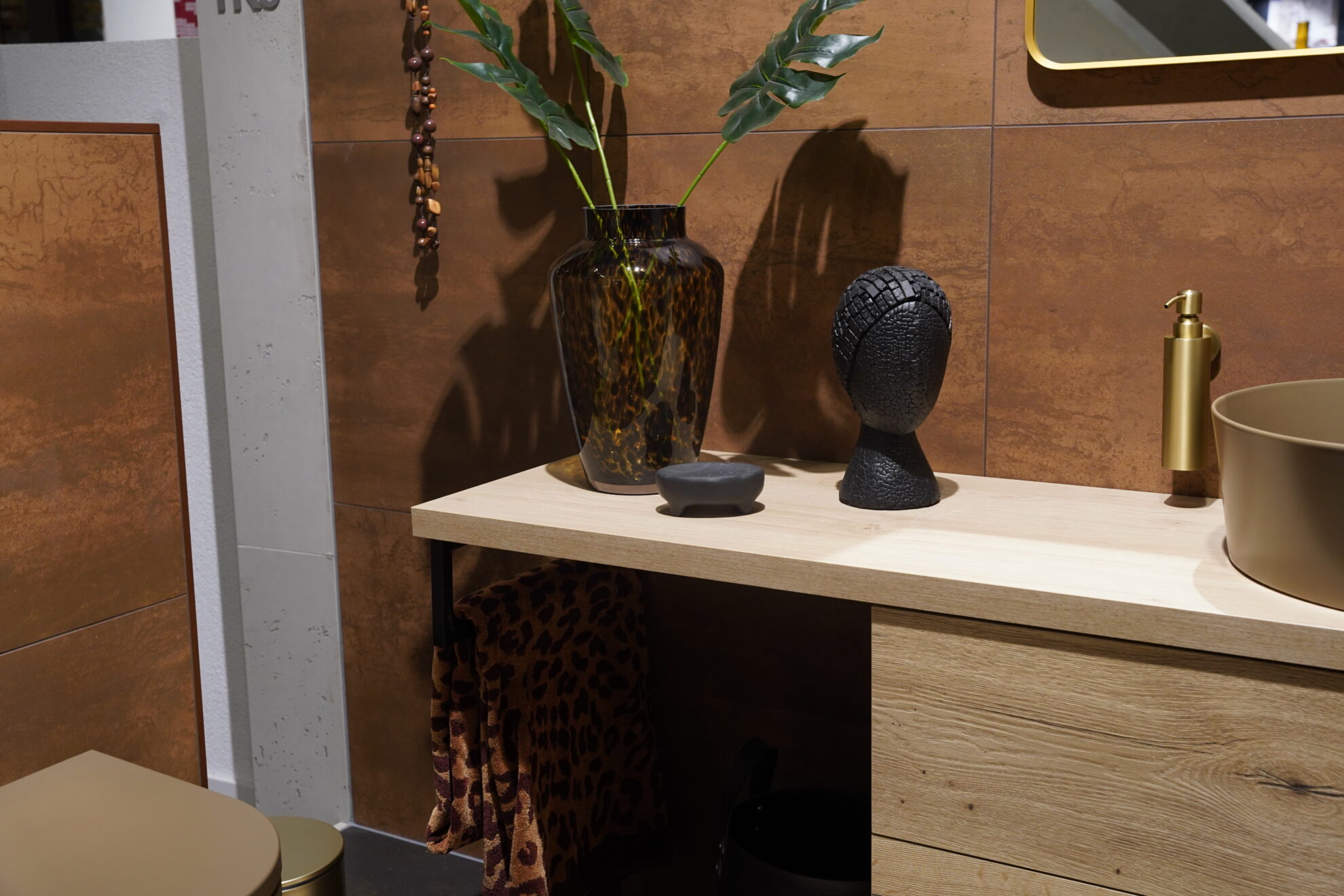
Why improving bathroom acoustics makes such a difference
Acoustics affect how you experience a space.
Compare an empty house with the same house once it has been furnished. Without furniture, curtains and other materials, every footstep sounds louder. Once the space is filled, the sound becomes softer.
Something similar happens in a bathroom.
However, you cannot simply add a large rug, fabric sofa or heavy curtains there. Materials need to be suitable for a humid environment.
That is why good bathroom acoustics require different solutions.
The goal is not to make the bathroom completely silent. It is mainly about reducing harsh reflections and echo, so the space feels calmer and more comfortable.
Improving bathroom acoustics starts with materials
When creating a calm bathroom, people often look at colour first. Beige, sand, greige, wood tones and other natural colours are commonly used to create warmth.
But colour is not the only factor that determines the atmosphere.
The texture of a material also plays a role.
A bathroom where every surface is hard, smooth and glossy can feel harsher both visually and acoustically. Combining different textures creates more balance.
Combine smooth and matte surfaces
You do not need to avoid glossy materials completely.
In fact, a combination often works best.
For example, pair smooth sanitaryware with matte wall finishes, wood-look furniture and tiles with a tactile texture. This not only adds more visual depth, but also makes the bathroom feel less clinical.
Large, fully tiled surfaces deserve particular attention. When both the floor and all walls are made of hard materials, sound can easily bounce back and forth.
Take a critical look at how much glass you use
Glass has become almost indispensable in the modern bathroom.
A transparent shower screen keeps sightlines open and can make a bathroom appear larger. However, glass is also a hard surface that strongly reflects sound.
That does not mean you should avoid choosing a glass shower screen.
It simply means you should consider the balance in the rest of the room.
Do you have a large glass shower screen, a large mirror, fully tiled walls and very little furniture? Then the bathroom contains many reflective surfaces.
A wooden or wood-look bathroom unit, suitable wall finishes or a few carefully selected accessories can then help soften the space.
Improving bathroom acoustics with bathroom furniture
A bathroom unit is much more than a place for your basin.
It is often one of the largest objects in the bathroom and therefore has a major influence on the overall look and feel of the space.
A unit with a wood texture, for example, immediately brings warmth to a bathroom with lots of tiles.
It can also contribute to a calmer atmosphere in practical ways.
Loose bottles, care products and appliances create visual clutter. By creating enough closed storage space, the area around the basin stays calm.
Visual and acoustic calm are not the same, but they do reinforce each other in the overall bathroom experience.
Also consider cabinet doors and drawers
Comfort can be found in the smallest details.
Drawers and cabinet doors that slam shut do not suit a bathroom designed for relaxation. Soft-close systems ensure that furniture closes smoothly and quietly.
You especially notice this early in the morning or late at night, when other people in the house are asleep.
A high-quality bathroom feels luxurious not only because it looks beautiful. The way its elements move and sound also matters.
Textiles are an easy way to soften sound
Textiles absorb sound far better than tiles or glass.
Fortunately, there is one type of textile that belongs in every bathroom: towels.
A stack of thick towels in an open shelf can therefore do more than add atmosphere. A bath mat can also contribute to a softer look and sound experience, provided it is suitable for the room and allowed to dry regularly.
If you have sufficient ventilation and a suitable place for them, you can consciously make textiles part of the design.
Do not overdo it. A bathroom remains a humid space where materials need to dry easily and be easy to clean.
Plants can contribute to a softer bathroom
Plants are often chosen for their natural appearance.
They bring colour and organic shapes into a space that mainly consists of straight lines and hard materials.
Plants can also be interesting for the overall acoustic experience. Leaves and irregular shapes make a surface feel less stark and bare.
Of course, choose plants that suit the conditions in your bathroom. Light, humidity and temperature all play an important role.
Do you have little natural light? Then it is wiser to first consider which plants are actually suitable, rather than choosing purely based on appearance.
Also consider sound outside the bathroom
When improving bathroom acoustics, we do not only look at echo inside the room.
Sound transfer to other rooms can be just as important.
This is especially noticeable when the bathroom is next to a bedroom. A shower, toilet or pipe against a shared wall can be quite audible early in the morning.
The position of sanitaryware can therefore be relevant.
If you still have the option to determine the layout, it is wise to think about what is located on the other side of each wall.
Pipes deserve attention
Water flowing through pipes can cause vibrations.
Good fixing and technical installation are therefore important. Pipe ducts, connections and the way components are installed can all affect the final level of comfort.
These are things that are much more difficult to adjust later.
That is why it is wise to discuss sound during the planning phase, rather than only when the bathroom is already finished.
A calm bathroom is more than a beige bathroom
Calming bathrooms are often associated with soft colours.
That is understandable. Beige, cream, sand, taupe and warm wood tones can create a calm foundation.
But true calm comes from combining several elements.
Think of clean sightlines, sufficient storage, pleasant materials, good proportions and a space that does not sound hollow or harsh.
After all, your senses experience more than colour alone.
You feel materials, hear water, notice changes in temperature and experience how much space there is around you.
If you want to design a bathroom as a relaxing environment, it is therefore worth looking beyond the colour palette alone.
Improve bathroom acoustics without compromising on style
The beauty is that many solutions which improve the acoustic experience also enhance the appearance of the room.
A wood-look unit adds warmth. Towels add softness. A matte wall creates a calm base. Plants bring organic shapes into the space.
So you do not have to choose between beauty and comfort.
Above all, try to prevent one material from dominating the entire bathroom.
A bathroom made almost entirely of large smooth tiles, glass and ceramic can look impressive, but it can also feel harsh. Add different textures and warmer elements, and the same space can have a completely different feel.
Five questions to ask yourself beforehand
Would you like to consciously consider sound and tranquillity in your new bathroom? Ask yourself these questions during the design process:
- How many hard surfaces will there be in the bathroom?
Look beyond tiles and also consider glass, mirrors and sanitaryware. - Which materials add softness and texture?
Think of wood-look finishes, matte surfaces, towels and organic shapes. - Is the bathroom next to a bedroom?
If so, sound transfer deserves extra attention. - Where will the shower, toilet and pipes be located?
Their position can affect sound in adjoining rooms. - How does the bathroom sound and feel as a whole?
A design should not only look beautiful on a mood board, but also feel pleasant in everyday use.
Improving bathroom acoustics as part of luxury
Luxury is often associated with large tiles, a freestanding bath, distinctive taps or a spacious bathroom unit.
But comfort is often found in the things you do not immediately see.
A drawer that closes quietly. A bathroom where your voice does not echo loudly. A shower that does not create unnecessary noise in the bedroom next door. A space that feels warm and welcoming rather than bare.
These are qualities you experience every day.
That is exactly why we believe it is important to look beyond the visible elements when designing a bathroom.
Improve bathroom acoustics? Include it in your design
If you want to improve bathroom acoustics, do not wait until the bathroom is finished. During the design stage, you can make smart choices in materials, furniture, sanitaryware and the placement of different elements.
At Jouwdroombadkamer, we look at the complete picture. Not only at how your new bathroom should look, but above all at how you want the space to feel and function every day.
Would you like a bathroom that is beautiful, practical and calming? Contact Jouwdroombadkamer or book a consultation. Together, we will discuss your wishes and explore how to create a comfortable bathroom where everything feels just right.